De Laval Separator Company
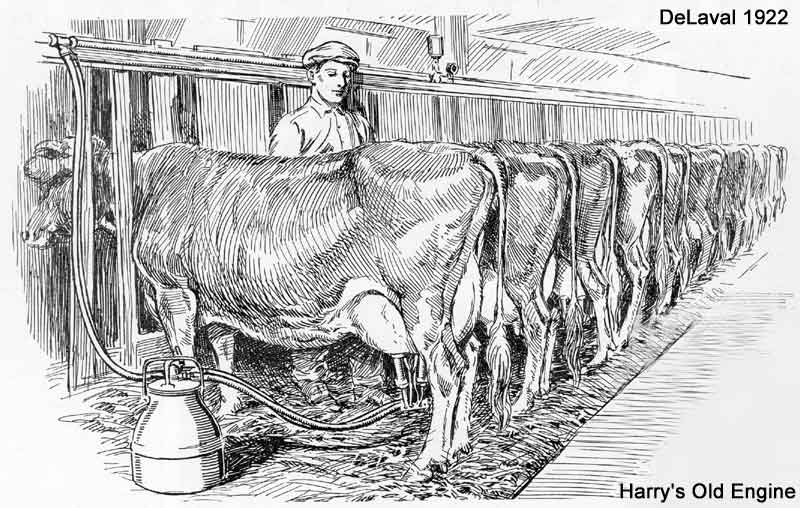
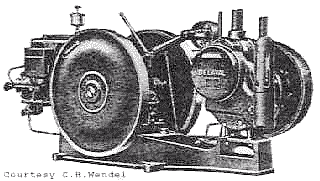
Milking Machine Engine
A bit of history and development of DeLaval Milkers from the company:
FROM time immemorial man has dreamed of a better way of milking- - some method which would eliminate the necessity of extracting the world's daily supply of milk by millions of laborious tiny hand squeezes.
Now that dream is a reality and the De Laval Milker is the answer to the long wanted and long needed method of better milking. But 'It was not until many years of patient research, experiment and practical trial, as shown in the following, had been devoted to the problem that it was ultimately and successfully solved.
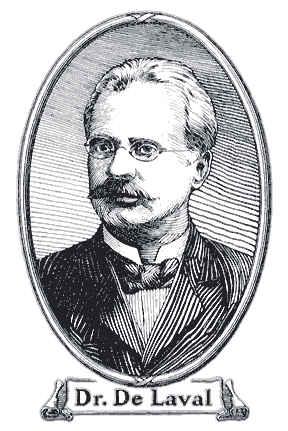
Many years ago Dr. De Laval, who invented the first continuous
discharge centrifugal cream separator, which has done more than any other factor to develop the dairy industry to its present magnitude, recognized the need for a mechanical milker if the dairy industry were to grow.
Dr. De Laval brought his great inventive genius, which was responsible for the invention of the steam turbine engine as well as the cream separator and many other scientific contributions of great importance, to bear upon the problem. He was granted his first patents upon a milker in 1894.
This first De Laval Milker had mechanically operated members to imitate the pressure of human hands. It milked cows successfully but was not commercially practical.
From that time until the present the De Laval Company has conducted almost continuous research, experiments and tests in order to perfect a mechanical milker. It is doubtful if any organization ever made a more thorough, prolonged and conscientious effort in order to perfect a machine.
In 1896 patents were applied for and issued in 1898 to Klein and Wright, employees of the De Laval Company, on a mechanical milker which operated under constant vacuum. It was not commercially practical.
In 1902, Hulbert and Park applied for patents, which were issued in 1904, on a milker which operated by means of compressed air cushions and vacuum. Experiments on this milker were continued by the De Laval Company and various types were made, upon which patents were issued in 1912, 1913 and 1914; and while machines of these types were developed which did fairly good work, they were not deemed sufficiently good.
Again the idea of imitating the action of human hands was taken up by the Company in two types of milkers known as the Ljungstrom. (patented 1904 and 1905) and the Dalen (patented 1910). These machines milked well but were too complicated.
In 1912 and 1914 patents were applied for and issued during 1914, and experiments continued on the Lindstrom type of milker. This milker was suspended from the cow close to the udder, had short milk tubes and operated by means of vacuum. This milker was later acquired by the European De Laval Company and its manufacture abandoned when it proved to be inefficient and impractical in use.
Up to this period every known method of mechanical milking had been De Laval tried - pressure to imitate human hands, compressed air and vacuum or suction for teat manipulation, and a great variety of pumps, pulsators, teat-cups, pails, etc.
The De Laval Company could have placed upon the market at this time several types of milkers, any one of which would have been as good as any then being offered for sale; but it was not felt that it was advisable to do so.
Experiments and research continued by Daysh, Leitch, Hulbert, Hall and others in the De Laval organization, and patents issued during 1914, 1915, 1916, 1917, 1918 and 1919, led to the development of the De Laval Milker, which was placed on the market in 1918. In this milker the new principle of controlling all the pulsations from the vacuum pump through a second or independent pipe line to secure uniformity of pulsations, simplicity of construction and reliability of operation, as well as many other exclusive features developed during these years, was first applied.
The principle of controlled and uniform pulsations as embodied in the De Laval Milker has proved beyond all question of doubt to be the most efficient and dependable type of milker ever developed, and is generally recognized as the correct principle of milking. Many thousands of these De Laval Milker outfits have been sold, and they are in use today milking more than one and a quarter million cows better than they were ever milked before.
From 1894, when Dr. De Laval was granted his first patents on a milker, until 1918, nineteen different types of milkers were developed by the organization, and more experience and information has been accumulated by the De Laval Research Department on this problem than by any other individual or organization in the world.
The Alpha Dairy Power Plant
The Alpha Senior Dairy Power Plant develops 1-1/2 or 2-1/2 hp. depending on the speed at which it is run and will operate from one to six milker units. Like the Alpha Junior Dairy Power Plant if is designed and built on automotive principles and is a smoothly powerful. economical and dependable source of power for dairy equipment, such as cream separators, chums. lighting plants, etc. It has a built-in water heater which, while the engine is being run for milking, heats 4-1/2 gallons of water for washing the milker and other utensils.
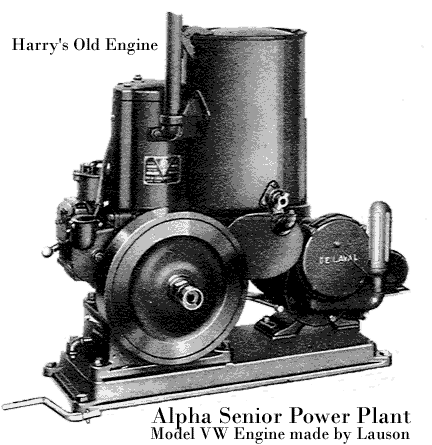
The Alpha Senior Dairy Power Plant is equipped with a built-in automatic governor control, counter balanced crankshaft mounted on roller bearings, plunger type oil pump, aluminum alloy piston, mechanically operated overhead valves, oil gauge, and a Hutto-ground cylinder. It has a rotary driven Wico Magneto which offers the most efficient and dependable ignition.
Because of its easy starting and dependability the Alpha Senior Dairy Power Plant is a pleasure to operate, and because of its advanced design and careful construction if is extremely economical. Hundreds of Alpha Dairy Power Plants are in use giving the greatest satisfaction on farms in every part of the country.
Milk - Separate Cream - Heat Water
and Generate Light All At The Same Time
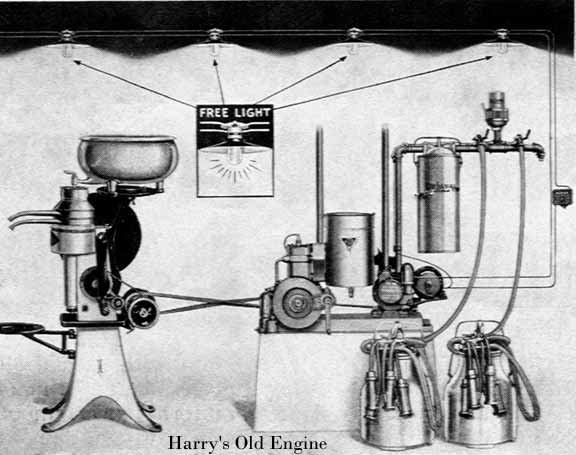
The Alpha Dairy Power Plant used in connection with a De Laval Magnetic Milker, De Laval Separator and De Laval BarnLighting Outfit provides a great combination of advantages.
The Alpha Dairy Power Plant supplies the power to operate the milker and the separator. The De Laval Magnetic Milker generates sufficient surplus current to operate the four special lamps of the De Laval Barn-Lighting Outfit.
While the power plant is providing the power to operate the separator and milker it also heats water which can be used to wash the separator, milker and other utensils. Therefore, with this outfit dairymen are not only receiving the best milking and the cleanest separating but also free hot water and electric light.
Many dairymen are using this system to reduce their production costs and thereby get all the profit from what they produce. In addition these De Laval machines make possible the production of a better product and add to the pleasure of dairying.
In many cases dairymen with electric power available select an Alpha Dairy Power Plant for use in connection with their De Laval Separator and Milker in order to have the advantage of its dependable, economical operation and the added features of free hot water and free light.
NOW YOU CAN HAVE PLENTY OF LIGHT WHILE YOU USE YOUR DE LAVAL MAGNETIC MILKER
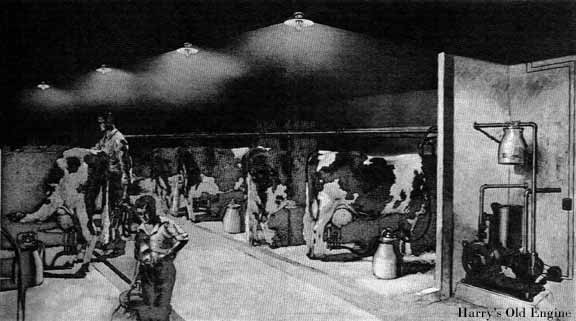
It is now possible for users of De Laval Magnetic Milkers to obtain electric lighting for their barns while the milker is in operation, at no extra expense beyond that of purchasing the lights, wire, etc., which is a relatively small item.
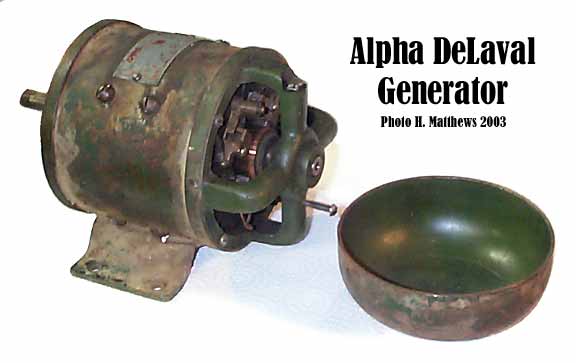
This is made possible by utilizing the surplus current from the generator on the pulso-pump of the De Laval Magnetic Milker. Enough surplus current is generated for four, 15-watt, 11-volt lamps, and is sufficient to light the ordinary barn in a very satisfactory manner.
This gives users of De Laval Magnetic Milkers another decided advantage which cannot be obtained with any other milker. When it is considered that it costs the user practically nothing to operate such lights, it is certain that every owner of a De Laval Milker will want this equipment.
These lights will do away with the use of lanterns during milking. are very much more satisfactory, more convenient, safer, and much less trouble. Should a user desire more than four lights he can obtain them by arranging switches so that the current may be shifted from one set of lights to another.
The circuit breaker serves two purposes. It insures that only the surplus current over that required for operating the milker will be utilized by the lights. Should too great a load be placed upon the generator the lights will be automatically cut out, thereby preventing any interference with the operation of the milker. It also serves as a switch when the lights are not required.
The method of securing light from the same plant that supplies power for milking the cows is a new idea and an ingenious one, yet what could be more simple or logical? During the greater part of the year cows are milked both morning and night during the dark hours and therefore light of some kind is an absolute essential.
This simple and efficient barn-lighting equipment operating in connection with the De Laval Magnetic Milker now makes it possible to obtain very satisfactory light white the milker is in operation. It supplies light when and where it is most needed, at practically no expense for maintenance.
THE SYSTEM
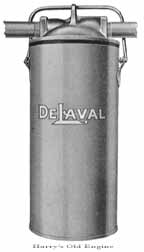
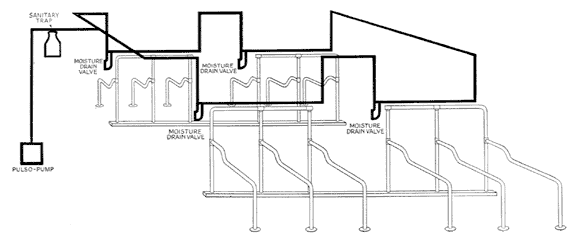
The Sanitary Trap catches any liquid or foreign substance, and prevents its getting into the pulso-pump. It has an automatic drain in the bottom. It is always located between the pulso-pump and the first stall or wash cock.
The trap is easily removed from its cover and should be taken down once a week and cleaned. An occasional coat of paint applied to the inside of the trap will prevent rusting.
The Vacuum Controller is installed in the vacuum line at a central point between the Pulso-Pump and the end of the vacuum lines farthest from the Pulso-Pump.
It is designed to maintain 15" of vacuum and it is not adjustable. When the Vacuum Controller is taking air, which is indicated by a hissing sound, it is evidence that 15" of vacuum is being maintained in the line, regardless of what the vacuum gauge may register.
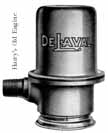
The screen around the lower body of the controller must not be permitted to get choked with dust, which would interfere with its working properly, and it may be cleaned by washing in kerosene if necessary.
About once each month remove the vertical valve from the cylinder and wipe it clean with a clean, dry cloth, after first removing the dome cover and valve weight. Do not attempt to remove the dome cover while the pulso-pump is running.
See that the rubber gasket below the dome cover is unbroken and that the cover seats properly on it. Under no circumstances attempt to increase or decrease the weight of the valve weight of the controller.
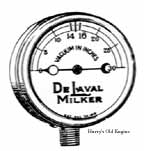
The Vacuum Gauge indicates the amount of vacuum in the vacuum line, and throughout the milking period when the vacuum controller is taking air it should register from 14' to 16'.
With the milker in operation, if the indicated vacuum is too low or too high, when the vacuum controller is admitting air, this is an indication that the gauge is out of adjustment. If the indicated vacuum is low and the vacuum controller is not admitting air, this would indicate an unusual leak in the vacuum line or possibly an open stall cock. The Vacuum Gauge is not furnished regularly with De Laval Milker Outfits.
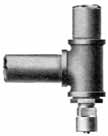
Moisture in vacuum pipes is usually caused by the moisture in warm air condensing in passing through cold metal pipes. This moisture, if permitted to remain in the pipes, serves as a trap for any dust that may be in the air passing through the pipes, and this accumulation of dust and dirt will restrict the flow of air through the pipes.
In cold stables, this moisture is apt to freeze, completely closing the vacuum pipe line. The Moisture Drain Valve will permit any accumulation of moisture to drain off automatically immediately after each milking.
THE MILKER
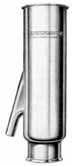 At the left is the stainless steel shell of the De Laval SpeedWay Teat Cup.
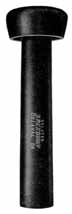 Right: The Speedway liner is a straight tube with molded mouthpiece and is made of De Laval "Delatex" rubber, which is tougher, longer lasting, more sanitary and heat and fat resistant.
The Udder Pulsator and Milk Claw come assembled. When attaching the teat cups make sure that the milk tube on the bottom of the teat cup is attached to the nipple on the milk claw and that the air tube on the side of the teat cup is attached to the nipple on the udder pulsator.
The check valve chamber can be removed by turning up the locking screw. When the check valve chamber is lifted up the double check valve can be removed. The cover, check valve, milk nipple and milk cock should be cleaned daily.
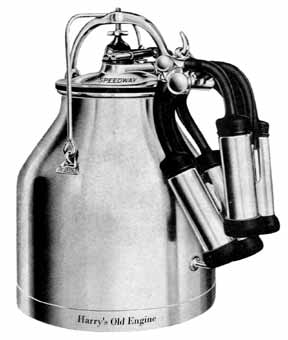
To assemble the unit connect udder pulsator and milk claw with the operating cover as follows. Slip one end of the twin tube on the air nipples of the check valve chamber of the operating cover, then hold the udder pulsator in an upright position as when milking cows and slip the other end of the twin tube on the air nipples of the udder pulsator.
Do not twist the air tube but connect as shown. If the twin tube is twisted the udder pulsator will not work. Now slip one end of the milk tube on the milk nipple of the operating cover and the other on the large milk nipple of the milk claw. Slip one end of the twin air tube over the large and small nipples on the other side of the check valve chamber and slip the other end over the large and small nipples of the Pulso-Magnet.
Hang the assembled udder pulsator and teat cups on the hook of the operating cover handle. Place the operating cover on the pail, snap the ball of the pail over the operating cover handle and the unit is completely assembled and ready for operation.
The CREAM SEPARATOR
Milk from the cow contains a number of large and small butter-fat particles held in suspension. They are lighter in weight than the other parts of the whole milk, much as would be the case were minute drops of oil mixed with a quantity of water.
When milk is left standing, the skim-milk gradually settles at the bottom because it is heavier. This forces the butter-fat to the top. When the bulk of the fat globules have found their way to the top they constitute cream, which consists largely of the fat particles.
In gravity setting the cream gradually finds its way to the top and is skimmed off, or the skim-milk may be drawn off from the bottom.
From prehistoric times it has been known that centrifugal force would separate substances of different specific gravities. Centuries ago the Chinese separated juices and oils from fruit pulp by whirling the crushed material in a calabash gourd at the end of a cord. About 1850 experiments began in earnest to employ centrifugal force for separating sugar cane juice and about 1859 the separating of cream from milk by centrifugal force WaS suggested. Several of these experimental devices were not practical because they had to be stopped in order to draw off the separated liquids, substantially as in the case of the Chinese gourd of centuries before.
In 1877 the attention of Dr. De Laval, a brilliant and successful young Swedish engineer, was called to the subject of centrifugal cream separation, and eventually Dr. De Laval evolved the first continuous cream separator, which discharged the cream and skim-milk separately while the milk was being fed into the machine, all of -which took place without stopping it or otherwise interrupting the operation.
The bowl of the separating vessel is the most important part of the cream separator. Its progressive development has consisted in improving the thoroughness of separation under hard as well as easy conditions and to secure greater separator capacity, at the same time requiring the least power or effort to run it.
Dr. De Laval's original bowl was a plain, hollow cylinder containingwings to keep the milk rotating with the bowl.
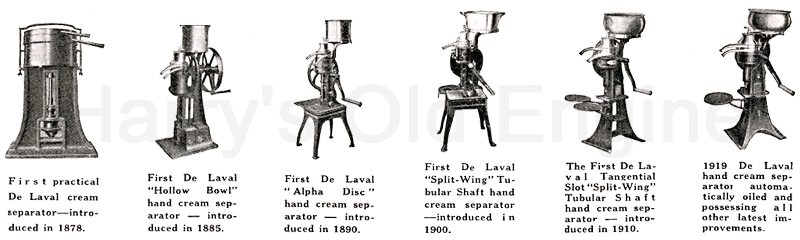
In 1890 the so-called "Alpha-disc" bowl was developed, which consisted of placing in the bowl a number of conical steel discs, one above the other and spaced slightly apart by thin caulks.
Fed into the center of the bowl. as before, the milk passed outward through the spaces between these discs in thin sheets so that the centrifugal force would separate the skim-milk from the cream with less difficulty than in the hollow bowl, where the milk and cream were in a solid mass.
This method greatly facilitated the process of separation. The skim-milk particles, being the heavier, were forced against the bottom side of each disc, traveling toward the periphery of the bowl, while the cream particles moved along the upper side of each disc toward the center. In this way no conflict of cream and skim-milk, occurred, which fact materially increased the skimming efficiency of the Alpha-disc bowl, while it doubled the capacity of a given size of bowl and likewise delivered cream in smoother and better condition.
The next important step in bowl construction, which further improved its efficiency, was the projecting and slotting of the wings of the central feed tube into the discs, thus carrying the incoming milk beyond the wall of separated cream and distributing it evenly between the discs. This proved to be nearly as great an improvement as was the placing of the discs in the "hollow" separator bowl. It rendered possible a complete separation of practically all butter-fat particles even under the harder conditions of separation, as in the case of cool milk, milk from cows advanced in lactation, and the running of extra thick cream. It likewise again increased by one-half the separating capacity of a given size of separator bowl.
Great as was the improvement effected by the "split-wing" device. it was but a stepping stone to another and still better bowl construction. In the present type of De Laval bowl, all the virtues of the "split-wing" construction are retained and certain objections inherent in it are eliminated, resulting in the capacity being increased approximately 10 percent, further increasing the efficiency of separation and overcoming entirely the possibility of clogging in separating cool milk.
While the frame construction and driving mechanism of a cream separator are of secondary importance to the bowl and largely influenced by its size and speed, at the same time there are many features of the utmost importance for complete separator satisfaction.
It is no simple matter to provide a means for revolving a separator bowl 6,000 to 8,000 revolutions a minute for feeding the milk into the bowl and conveying the cream and skimmilk from it; to permit easy hand turning whether during a few minutes or during during half an hour, or more. Every part part must be simple, easily cleaned and extremely durable.
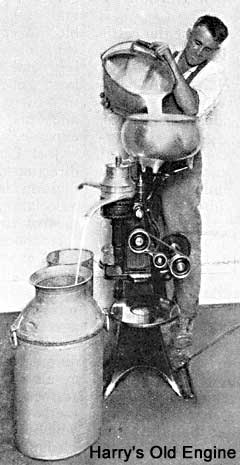
Hence the cream separator must necessarily be a different and far better built piece of machinery than any agricultural implement if it is to prove satisfactory and durable.
The development of the cream separator marks the beginning of the rapid development of the dairy industry throughout the world. It has put dairying on a paying basis. It has furnished a means for better homes, for better barns and for better equipment. It has done more than any other one influence to develop the country along dairy lines. The western farmers, who had been depending on grain, found that they were growing poorer each year. They were unable to market what milk they produced at a profit. The cream separator came to their rescue. With it they were able to take out the cream quickly and completely, and ship it to the creamery even if it were a hundred miles distant. Their cream brought cash instead of trade. The separator broadened their market to include everv creamery within many miles and, because of the high quality of the cream, they were able to get a larger cash income than they ever dreamed was possible. This income was steady and sure, and enabled them to pay cash as they went along.
Therefore, the cream separator is universally recognized as having been one of the greatest factors in modernizing dairying, quadrupling dairy production, saving much time and labor as well as a large percentage of butter-fat formerly wasted, and greatly improving the quality of cream and butter.
See my Alpha Horizontal and my Lauson Vertical gas engines that ran the vacuum pumps for these milkers.
| 
 Page!
Page!